

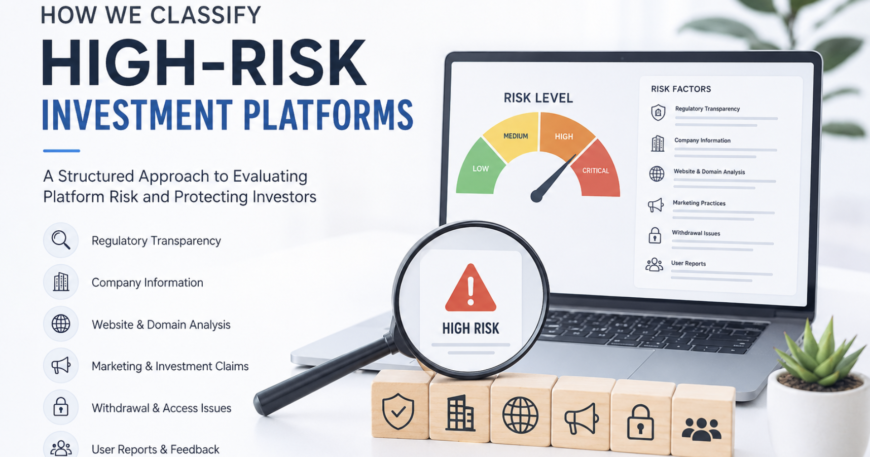
How We Classify High-Risk Investment Platforms: Validor Risk Classification Framework (VRCF)
How we classify high-risk investment platforms is a structured, evidence-based process designed to identify potential investor risk before financial harm occurs.
Methodology Update Log
How we classify high-risk investment platforms is based on a structured, evidence-driven methodology known as the Validor Risk Classification Framework (VRCF).
June 2026 — Introduced enhanced behavioural intelligence review procedures and expanded withdrawal-pattern analysis.
January 2026 — Added technical infrastructure intelligence and cross-platform relationship analysis.
August 2025 — Initial publication of the Validor Risk Classification Framework (VRCF).
Last Updated: June 2026
Framework Version: VRCF 2.0
Reviewed By: Validor Investigation Team
Review Cycle: Quarterly Methodology Review
Purpose: The Validor Risk Classification Framework (VRCF) is a proprietary methodology used to evaluate investment platforms, brokers, crypto services, and financial entities that may present elevated risk to investors.
Regulatory Alignment: The framework incorporates investor protection principles commonly promoted by major financial regulators, including the FCA, SEC, ESMA, ASIC, and other recognised financial authorities.
Why This Framework Exists
Investment scams have become increasingly sophisticated.
Many high-risk platforms maintain professional websites, persuasive account managers, fabricated regulatory claims, and convincing marketing materials that make them difficult for investors to identify.
The Validor Risk Classification Framework was developed to provide a structured, evidence-based process for evaluating risk indicators before significant investor harm occurs.
Rather than relying on isolated complaints or assumptions, VRCF evaluates multiple independent evidence sources and applies consistent investigation standards across every assessment.
How we classify high-risk investment platforms depends on evaluating multiple independent intelligence layers rather than isolated complaints.
How we classify high-risk investment platforms is designed to identify patterns that are not visible through isolated complaints or surface-level reviews.
Table of Contents
- Why Risk Classification Matters
- What Is the Validor Risk Classification Framework?
- Evidence Hierarchy
- Investigation Standards
- False Positive Prevention
- Framework Overview
- Regulatory Intelligence Layer
- Corporate Transparency Layer
- Behavioural Intelligence Layer
- Technical Intelligence Layer
- Investor Evidence Layer
- Risk Classification Methodology
- Frequently Asked Questions
Why Risk Classification Matters
Not all investment platforms present the same level of risk.
While some operate transparently and maintain verifiable regulatory credentials, others display behavioural, operational, and technical indicators that may significantly increase the likelihood of investor harm.
Many fraudulent operations are designed to appear legitimate during the initial stages of investor engagement.
Professional branding, persuasive communication, fabricated licences, and manipulated performance claims often create a false sense of trust.
By the time warning signs become obvious, substantial losses may already have occurred.
The purpose of VRCF is to identify risk indicators before those losses occur by applying a structured evidence-based assessment process.
- Improve investor awareness
- Support informed decision-making
- Encourage due diligence
- Create consistent platform evaluations
- Reduce exposure to financial fraud
- Strengthen early-risk detection
How We Classify High-Risk Investment Platforms: What Is the Validor Risk Classification Framework (VRCF)?
The Validor Risk Classification Framework (VRCF) is a multi-layer investigative methodology developed to assess investment platforms using independent evidence categories.
Unlike simple review systems that rely primarily on user opinions or public ratings, VRCF combines regulatory intelligence, corporate transparency analysis, behavioural investigations, technical intelligence, and investor evidence into a unified risk assessment model.
The framework was designed specifically to improve consistency, reduce subjectivity, and strengthen evidence-based platform evaluations.
No platform is classified using a single indicator.
Classifications occur only when multiple independent signals consistently support the same risk profile.
How We Classify High-Risk Investment Platforms: Evidence Hierarchy
Not all evidence carries the same weight.
VRCF applies an evidence hierarchy that prioritises objective and independently verifiable information sources.
- Official regulatory records and warnings
- Corporate registration and business records
- Technical infrastructure intelligence
- Verified investor documentation
- Independent corroborating reports
- Behavioural pattern analysis
Evidence from multiple categories generally carries greater weight than evidence originating from a single source.
Investigation Standards
To maintain consistency and reduce bias, every platform evaluation follows core investigation standards.
- No platform is classified based solely on a single investor report.
- Multiple independent indicators are required before elevated risk classifications are assigned.
- Evidence is reviewed across multiple categories whenever possible.
- Classifications remain subject to revision if new information becomes available.
- Investigations prioritise verifiable information over speculation.
- Conflicting evidence is reviewed before final assessments are made.
False Positive Prevention
An important objective of VRCF is reducing the likelihood of false positive classifications.
Legitimate businesses can experience operational issues, customer complaints, or temporary disruptions without necessarily presenting elevated fraud risk.
For this reason, classifications are based on evidence convergence rather than isolated incidents.
Risk assessments become stronger when regulatory concerns, technical indicators, behavioural patterns, and investor reports independently support similar conclusions.
Verify a Platform Before Investing
Understanding risk indicators before depositing funds can significantly reduce exposure to investment fraud.
How We Classify High-Risk Investment Platforms: Frame Work Overview
The Validor Risk Classification Framework consists of five independent intelligence layers.
How we classify high-risk investment platforms is based on multiple independent intelligence layers including regulatory, behavioural, technical, and investor evidence.
Each layer evaluates a different category of evidence and contributes to the overall risk assessment process.
VRCF Evidence Flow Model
Regulatory Intelligence
↓
Corporate Transparency Analysis
↓
Behavioural Intelligence
↓
Technical Intelligence
↓
Investor Evidence
↓
Risk Classification Outcome
The following sections explain how each intelligence layer contributes to the overall VRCF methodology.
Regulatory Intelligence Layer
The first layer of the Validor Risk Classification Framework evaluates regulatory transparency and independently verifiable regulatory information.
Regulatory analysis provides one of the strongest forms of objective evidence available during platform evaluations because it relies on information originating from recognised financial authorities rather than platform-controlled marketing materials.
During this stage, investigators review:
- Regulatory licence disclosures
- Licence verification records
- Regulatory warning databases
- Authorisation status
- Jurisdictional legitimacy
- Corporate-regulatory consistency
- Cross-border compliance indicators
Key questions include:
- Does the platform identify the entity operating the service?
- Can the claimed licence be independently verified?
- Do company records match regulatory disclosures?
- Has the entity been subject to warnings or alerts?
- Are investors able to verify oversight independently?
A lack of regulatory transparency does not automatically indicate fraud. However, regulatory inconsistencies become significantly more important when combined with additional risk indicators identified in other intelligence layers.
Corporate Transparency Layer
Corporate transparency analysis focuses on identifying the individuals, entities, and business structures responsible for operating a platform.
Legitimate financial businesses generally maintain verifiable ownership records, clear operational disclosures, and consistent corporate identities.
Our review process examines:
- Company registration records
- Corporate ownership disclosures
- Director information
- Business history
- Registered office details
- Operational continuity
- Corporate structure complexity
Common concerns identified during investigations include:
- Anonymous ownership
- Missing company information
- Conflicting business identities
- Recently established entities
- Unverifiable corporate addresses
- Frequent corporate restructuring
Ownership transparency remains one of the most important indicators of platform legitimacy.
Behavioural Intelligence Layer
Behavioural intelligence focuses on identifying recurring operational patterns observed across multiple investor reports and investigations.
Unlike marketing claims or public disclosures, behavioural patterns often reveal how a platform operates in practice.
The framework evaluates:
- Communication behaviour
- Sales tactics
- Account management practices
- Withdrawal handling procedures
- Escalation behaviour
- Complaint responses
- Investor treatment patterns
Withdrawal Manipulation Indicators
- Unexpected release fees
- Tax payment requests before withdrawals
- Repeated clearance charges
- Changing withdrawal requirements
- Conditional access to funds
Communication Risk Indicators
- Support teams becoming unresponsive
- Migration to encrypted messaging apps
- Avoidance of written communication
- Disappearing account managers
- Delays following withdrawal requests
Deposit Escalation Indicators
- Pressure to increase deposits
- Promises of enhanced returns
- Urgent funding requests
- Bonus structures tied to additional deposits
- Claims that further payments unlock withdrawals
Behavioural Intelligence Standard
Behavioural indicators are not treated as isolated evidence. Patterns become significant when repeated across multiple independent reports and supported by corroborating information.
Technical Intelligence Layer
Technical intelligence provides additional context regarding the infrastructure supporting a platform.
Many operational relationships become visible only through technical analysis.
The VRCF technical review may include:
- Domain registration history
- Ownership changes
- WHOIS intelligence
- DNS changes
- Hosting infrastructure analysis
- Website cloning patterns
- Historical website records
- Cross-platform infrastructure relationships
- Network-level associations
Technical findings rarely determine risk classifications independently.
However, they often strengthen confidence levels when behavioural, corporate, and regulatory findings point toward similar conclusions.
Investor Evidence Layer
Investor evidence represents an important source of real-world operational intelligence.
Many platform risks become visible only after investors attempt withdrawals, dispute transactions, request account closures, or challenge platform representations.
The framework evaluates:
- Documented investor submissions
- Withdrawal experiences
- Communication records
- Transaction evidence
- Account restrictions
- Fee demands
- Complaint patterns
Investor reports alone do not determine classifications.
However, when multiple independent submissions describe similar experiences, they may provide valuable evidence supporting broader investigative findings.
How We Classify High-Risk Investment Platforms: Risk Classification Methodology
Once all intelligence layers have been reviewed, investigators assess the overall convergence of evidence.
The framework does not rely on a single risk score generated by software.
Instead, risk classifications are determined through evidence-weighted analysis across all available intelligence categories.
Low Risk Classification
Evidence generally supports transparency, operational consistency, and independently verifiable legitimacy.
Moderate Risk Classification
Certain concerns or inconsistencies exist, but evidence remains insufficient to support elevated-risk conclusions.
High Risk Classification
Multiple independent indicators consistently support elevated investor risk concerns.
Critical Risk Classification
Strong evidence convergence suggests substantial investor risk, significant operational concerns, or repeated harmful behavioral patterns.
The greater the convergence across regulatory, corporate, behavioral, technical, and investor evidence layers, the stronger the overall confidence level of a classification.
How we classify high-risk investment platforms relies on evidence convergence across multiple intelligence layers rather than single indicators.
Need Help Assessing a Platform?
The same framework described above is used during The Validor platform investigations and risk assessments.
Classification Review & Monitoring Protocol
Risk classifications are not permanent.
Financial platforms, brokers, and investment entities may change ownership, improve transparency, resolve complaints, receive regulatory approvals, or become subject to new investigations over time.
For this reason, the Validor Risk Classification Framework incorporates an ongoing monitoring process designed to ensure classifications remain accurate, evidence-based, and relevant.
Reviews may be triggered by:
- New investor reports
- Regulatory warnings or enforcement actions
- Corporate ownership changes
- Updated licensing information
- Technical infrastructure changes
- Significant operational developments
- Additional evidence submissions
Where new information materially changes a platform’s risk profile, classifications may be revised accordingly.
Quality Assurance & Classification Integrity
Maintaining classification integrity is a core objective of the VRCF methodology.
To support consistency and reliability, assessments follow structured review procedures before classifications are assigned.
- Evidence reviewed across multiple intelligence layers
- Independent verification where possible
- Priority given to verifiable evidence sources
- Consideration of conflicting information
- Ongoing monitoring after publication
- Periodic methodology review cycles
The framework is designed to reduce subjective decision-making and strengthen evidence-based assessments.
Industry Observations
Across hundreds of reviewed investor submissions, several recurring themes consistently emerge within elevated-risk platform investigations.
- Withdrawal-related disputes remain the most common complaint category.
- Unverifiable regulatory claims frequently appear alongside broader transparency concerns.
- Pressure-based account management tactics often precede requests for additional deposits.
- Communication breakdowns commonly occur following withdrawal requests.
- Technical infrastructure links may reveal relationships between seemingly unrelated platforms.
While no single observation determines risk independently, recurring patterns contribute valuable context during investigations.
Framework Limitations
No investigative methodology can eliminate uncertainty entirely.
The VRCF framework evaluates available evidence and applies structured analysis to identify risk indicators, but it cannot guarantee future outcomes or predict future platform behaviour.
Classifications should therefore be viewed as evidence-based assessments rather than guarantees, legal determinations, or financial advice.
Investors should always conduct independent due diligence before making investment decisions.
Framework Principle
No platform is classified based on a single complaint, a single technical indicator, or a single regulatory concern. The Validor Risk Classification Framework relies on evidence convergence across multiple independent intelligence layers before elevated-risk classifications are assigned.
Frequently Asked Questions
What Is the Validor Risk Classification Framework (VRCF)?
VRCF is Validor’s proprietary methodology for evaluating investment platforms, brokers, crypto services, and financial entities using multiple independent evidence categories.
How we classify high-risk investment platforms is based on a multi-layer investigative framework that reduces reliance on single-source evidence.
Does a High-Risk Classification Mean a Platform Is Fraudulent?
Not necessarily. Risk classifications identify elevated risk indicators based on available evidence. They are not legal findings, criminal determinations, or regulatory judgments.
How Often Are Classifications Reviewed?
Classifications may be reviewed whenever new evidence becomes available or significant developments occur that could materially affect the platform’s risk profile.
Can a Platform Move Between Risk Categories?
Yes. Risk classifications may increase or decrease as new evidence emerges, transparency improves, or operational circumstances change.
What Evidence Carries the Greatest Weight?
Regulatory records, corporate documentation, independently verifiable evidence, and corroborated findings generally carry greater weight than isolated reports.
Why Doesn’t Validor Rely Only on Investor Reviews?
Investor reports provide valuable insights, but they represent only one evidence category. VRCF incorporates multiple independent intelligence layers to improve accuracy and reduce bias.
Can Technical Analysis Alone Trigger a High-Risk Classification?
No. Technical findings are considered alongside regulatory, corporate, behavioural, and investor evidence.
What Is Evidence Convergence?
Evidence convergence occurs when multiple independent intelligence layers support the same risk assessment outcome.
Can Businesses Challenge Classifications?
Where new verifiable evidence becomes available, assessments may be reviewed and updated accordingly.
Does VRCF Provide Financial Advice?
No. VRCF is an investigative and educational framework designed to support risk awareness and due diligence.
Need Help Reviewing an Investment Platform?
If you are concerned about a broker, investment platform, crypto service, or financial entity, Validor can conduct a structured review using the same methodology outlined in the VRCF framework.
Conclusion
The Validor Risk Classification Framework (VRCF) was developed to provide a structured, evidence-based approach to evaluating investment platform risk.
Rather than relying on assumptions, isolated complaints, or single warning signs, the framework evaluates multiple independent intelligence layers to create a more complete understanding of potential investor risk.
Regulatory intelligence, corporate transparency analysis, behavioural investigations, technical intelligence, and investor evidence each contribute to the overall assessment process.
By applying consistent investigation standards, evidence hierarchy principles, and ongoing monitoring procedures, VRCF aims to improve investor awareness and support more informed decision-making.
As investment scams continue to evolve, structured risk assessment remains one of the most effective tools available for identifying potentially harmful platforms before significant losses occur.
How we classify high-risk investment platforms is designed to ensure consistent, evidence-based assessments across all investigations.
How we classify high-risk investment platforms is designed to ensure consistent, evidence-based assessments across all cases.
Related Resources
Editorial Oversight
This methodology is reviewed and maintained by the Validor Investigation Team, an editorial group responsible for platform investigations, investor risk assessments, scam pattern analysis, and methodology governance.
- Quarterly framework reviews
- Ongoing methodology updates
- Evidence verification procedures
- Classification integrity monitoring
- Investor protection research
Last Editorial Review: June 2026
Methodology References
The Validor Risk Classification Framework incorporates investigative principles and investor protection concepts commonly reflected within the following public resources:

