

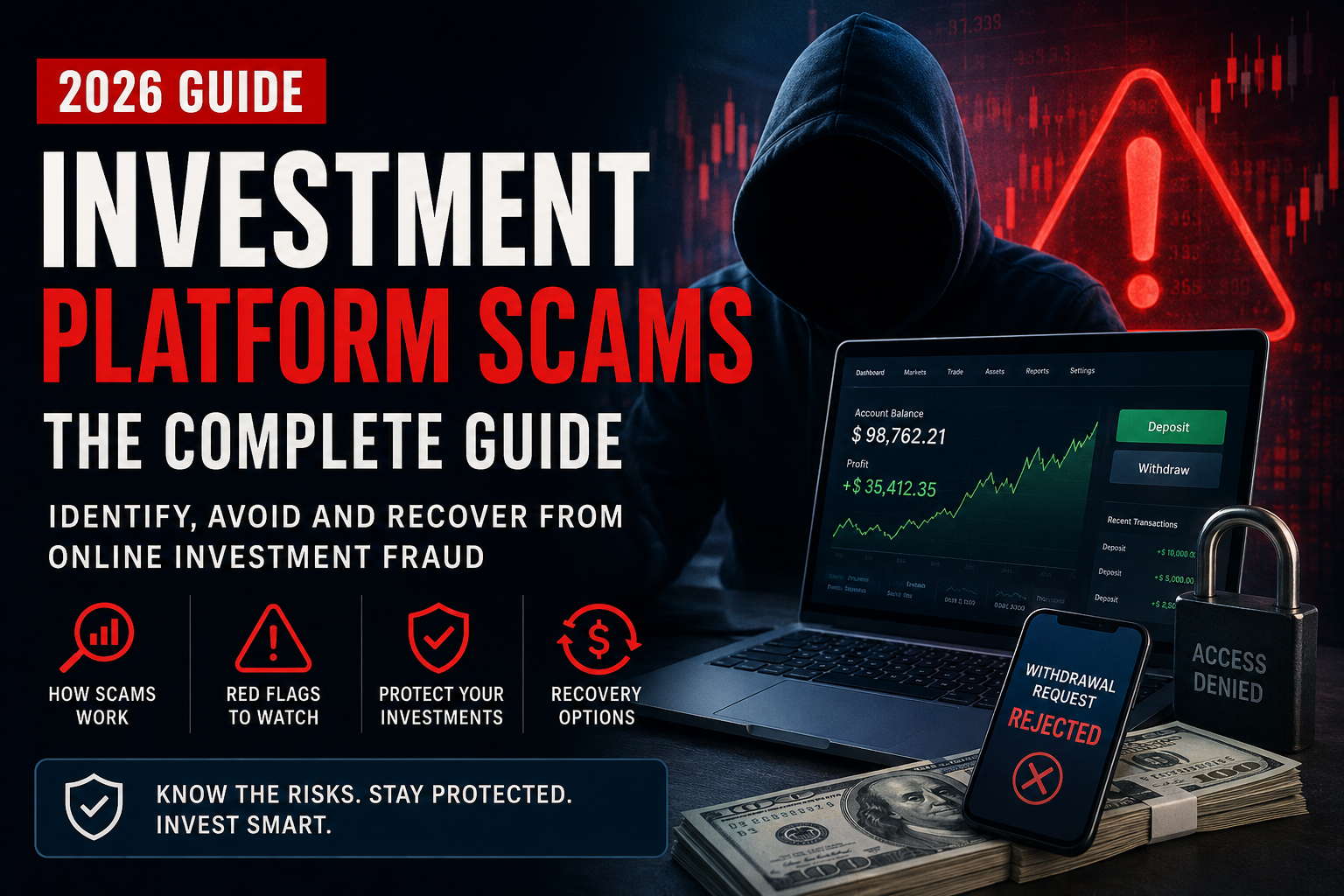
The Complete Guide to Investment Platform Scams (2026)
Investment platform scams are among the fastest-growing forms of online financial fraud. Understanding investment platform scams is essential before depositing funds into any trading platform.
Investment platform scams continue to affect investors worldwide, resulting in substantial financial losses, delayed withdrawals, and ongoing disputes with unregulated or deceptive operators. As online investing becomes more accessible, fraudulent platforms have become increasingly sophisticated in the way they attract, persuade, and retain victims.
Many scam platforms present themselves as legitimate brokers, cryptocurrency exchanges, investment advisors, or wealth management firms. Their websites often appear professional, customer support may seem responsive, and account dashboards can display convincing trading activity. However, investors frequently discover problems only after attempting to withdraw funds or verify the legitimacy of the platform.
This guide explains how investment platform scams operate, the warning signs investors should recognize, how fake brokers manipulate victims, why withdrawal issues occur, and what steps may help reduce risk before investing.
For additional guidance on evaluating platforms, review our Platform Evaluation Methodology.
What Are Investment Platform Scams?
An investment platform scam is a fraudulent or deceptive operation that presents itself as a legitimate investment opportunity while using misleading information, false representations, or manipulative tactics to obtain deposits from investors.
Investment platform scams typically involve deceptive financial platforms presenting themselves as legitimate investment services
These schemes may target individuals interested in:
- Forex trading
- Cryptocurrency investing
- Stock trading
- Commodities trading
- Managed investment accounts
- Passive income opportunities
- Alternative investment programs
While every case is different, many scam platforms share common characteristics. They often operate with limited transparency, provide vague information regarding ownership, make unrealistic claims regarding returns, and create obstacles when investors attempt to withdraw funds.
Understanding these patterns can help investors identify risks before significant financial losses occur.
Common Types of Investment Platform Scams
Investment fraud can take many forms. Some schemes focus on cryptocurrency investments, while others imitate traditional brokerage services.
- Fake Broker Platforms – Websites that claim to offer trading services without genuine market access.
- Clone Firms – Platforms that imitate legitimate financial institutions.
- Crypto Investment Scams – Operations promoting unrealistic cryptocurrency returns.
- Managed Account Schemes – Programs where investors surrender control of funds to supposed experts.
- High-Yield Investment Programs – Schemes promising unusually high profits with little or no risk.
- Advance Fee Scams – Fraudulent operations requiring ongoing payments before withdrawals are released.
Many of these operations evolve over time and frequently change names, domains, or business structures to avoid scrutiny.
Learn how The Validor evaluates platform risk through our High-Risk Investment Platform Classification Framework.
Why Investment Platform Scams Continue to Grow
The rapid growth of online investing has created opportunities for both legitimate businesses and fraudulent operators. Modern scam platforms can launch quickly, advertise globally, and communicate directly with investors through multiple channels.
Several factors contribute to the continued growth of investment fraud:
- Increased interest in cryptocurrency and digital assets
- Global access to online financial services
- Low barriers to creating professional-looking websites
- Use of social media marketing
- International operations across multiple jurisdictions
- Anonymous payment methods
- Difficulty verifying ownership structures
Many investors encounter these platforms through online advertisements, messaging applications, social media groups, referral programs, or direct outreach from individuals claiming to represent investment firms.
Because many platforms appear legitimate at first glance, investors may not recognize warning signs until significant deposits have already been made.
The Typical Lifecycle of an Investment Platform Scams
Although individual scams vary, many follow a predictable sequence.
- Initial contact through advertising, social media, or referrals.
- Creation of trust through conversations and platform demonstrations.
- Small initial deposit.
- Display of apparent profits within the account dashboard.
- Pressure to increase investment amounts.
- Withdrawal request submitted.
- Unexpected restrictions, fees, or delays.
- Communication breakdown or platform disappearance.
Understanding this lifecycle can help investors identify potential issues before losses increase.
For additional warning signs, see Signs of Investment Fraud: How to Identify Scams in 2026.
Why Education and Verification Matter
Many investment scams rely on urgency, emotion, and limited due diligence. Investors are often encouraged to act quickly before opportunities supposedly disappear.
However, legitimate investment decisions should never require immediate action without independent verification.
Before transferring funds, investors should consider:
- Verifying company registration details
- Researching platform ownership
- Reviewing domain history
- Checking regulatory status
- Investigating complaints and warnings
- Assessing platform transparency
- Understanding withdrawal procedures
Independent verification can often reveal inconsistencies that are not immediately visible on a platform’s website.
Read our guide on How to Verify a Trading Platform Before Investing.
How Fake Brokers Attract Victims
Most investment platform scams do not begin with large financial requests. Instead, fraudulent operators focus on building credibility, creating trust, and encouraging small initial deposits that gradually increase over time.
Modern scam platforms often use sophisticated marketing strategies that closely resemble those used by legitimate financial businesses. Professional websites, convincing branding, persuasive sales representatives, and seemingly successful investors are commonly used to create a false sense of security.
Understanding how fake brokers attract victims is one of the most effective ways to recognize warning signs before funds are transferred.
For a deeper analysis, read How Fake Brokers Manipulate Victims: 7 Scam Tactics.
Social Media Advertising Campaigns
Social media platforms have become one of the most common methods used by fraudulent investment operations. Advertisements frequently promote wealth-building opportunities, cryptocurrency investments, automated trading systems, or passive income programs.
These advertisements are often highly targeted and may appear to be endorsed by successful investors or financial professionals.
Common claims include:
- Guaranteed profits
- Low-risk investment opportunities
- AI-powered trading systems
- Exclusive insider strategies
- Rapid account growth
- Passive income opportunities
While not every investment advertisement is fraudulent, investors should be cautious when marketing materials emphasize extraordinary returns without discussing meaningful risks.
Messaging Applications and Private Groups
Many fraudulent operators move conversations away from public platforms and into private communication channels.
Commonly used applications include:
- Telegram
- Signal
- Discord
- Private social media groups
These groups often contain individuals who appear to be ordinary investors sharing positive experiences and profit screenshots. In some cases, these participants may be associated with the platform itself or otherwise contribute to a controlled environment designed to influence investor behavior.
The goal is often to create social proof and reinforce the belief that the investment opportunity is legitimate.
Fake Success Stories and Testimonials
One of the most powerful tools used by investment scammers is the success story.
Potential investors may encounter:
- Screenshots showing large profits
- Video testimonials
- Customer reviews
- Case studies
- Luxury lifestyle content
- Withdrawal confirmations
While some testimonials may represent genuine experiences, investors should independently verify information whenever possible. Fraudulent operators frequently use fabricated reviews or selectively display positive feedback while ignoring complaints.
Investors should be especially cautious when multiple reviews contain nearly identical language or unusually exaggerated claims.
The Dedicated Account Manager Strategy
Many investment platforms assign a personal account manager shortly after registration.
This individual may present themselves as:
- A senior financial analyst
- A trading specialist
- A portfolio manager
- A cryptocurrency expert
- An investment consultant
The account manager often becomes the primary point of contact and may communicate frequently through phone calls, emails, and messaging applications.
Initially, these conversations typically focus on education and support. Over time, however, investors may be encouraged to increase deposits, participate in special promotions, or take advantage of supposedly limited opportunities.
In many reported cases, communication changes significantly once withdrawal requests are submitted.
Many victims of investment platform scams do not realize they are dealing with fraudulent systems until withdrawal issues begin.
The Small Withdrawal Technique
Some platforms intentionally process small withdrawal requests during the early stages of the relationship.
This tactic can create confidence because investors believe the platform is operating legitimately.
After successful small withdrawals, investors may:
- Increase deposits significantly
- Refer friends and family members
- Invest retirement savings
- Transfer cryptocurrency holdings
- Commit additional capital
Withdrawal issues often emerge only after larger balances accumulate within the account.
Artificial Profit Generation
Many investors are encouraged by what appears to be strong account performance.
Account dashboards may display:
- Consistent profits
- Successful trades
- Growing account balances
- Bonus credits
- Portfolio appreciation
However, account displays alone do not necessarily prove that trades are occurring within legitimate financial markets.
Independent verification remains essential before relying on account balances shown by any platform.
Fear of Missing Out (FOMO)
Psychological pressure plays a significant role in many investment scams.
Investors may be told:
- A special opportunity is ending soon
- Market conditions are ideal right now
- Other investors are earning substantial profits
- A promotion is about to expire
- A bonus requires immediate action
These tactics are designed to reduce the amount of time available for independent research and due diligence.
Legitimate investment opportunities should withstand careful review and verification.
Romance and Relationship-Based Investment Scams
Some investment scams begin through personal relationships rather than financial advertising.
Fraudsters may spend weeks or months building trust before introducing investment opportunities.
These schemes often involve:
- Long-term online communication
- Emotional relationship development
- Investment recommendations
- Introductions to trading platforms
- Claims of successful investing experiences
Because trust has already been established, victims may be less likely to question the legitimacy of the platform being recommended.
How To Identify Manipulation Before Investing
Investors can reduce risk by recognizing common manipulation techniques early.
Warning signs may include:
- Pressure to deposit quickly
- Guaranteed returns
- Difficulty verifying company ownership
- Unsolicited investment recommendations
- Repeated requests for additional funds
- Promises of unusually high profits
- Limited transparency regarding regulation
Before committing funds, investors should perform independent verification and investigate the platform’s history, ownership structure, regulatory claims, and public reputation.
Learn more about identifying suspicious platforms in Red Flags Found in Fraudulent Trading Platforms.
Investors should also review Is My Broker Legit? Fake Financial Advisor Report 2026 before making investment decisions.
Warning Signs Before You Deposit Funds
Many investment platform scams display warning signs long before withdrawal problems occur. Unfortunately, investors often focus on promised returns while overlooking indicators that may suggest elevated risk.
Performing due diligence before sending funds can significantly reduce exposure to fraudulent platforms. While no single warning sign automatically proves a platform is fraudulent, multiple concerns appearing together should prompt further investigation.
The most effective approach is to verify every claim independently rather than relying solely on information presented by the platform itself.
Missing or Unclear Regulatory Information
Legitimate financial firms typically provide clear information regarding their registration status, licensing details, company ownership, and operating jurisdiction.
Warning signs may include:
- No regulatory information displayed
- Vague licensing claims
- References to regulators without registration numbers
- Conflicting company information
- Unclear ownership structures
- Offshore entities with limited transparency
Investors should independently verify any claimed registration or licensing information through official regulatory databases whenever possible.
Learn more about platform verification in our guide: How to Verify a Trading Platform Before Investing.
Fake Licenses and Misleading Regulatory Claims
Some platforms display regulator logos or claim to be licensed without providing sufficient evidence.
Common examples include:
- Fake license numbers
- Expired registrations
- Unauthorized use of regulator logos
- Claims of regulation in unrelated jurisdictions
- References to shell companies
Investors should never assume a platform is regulated simply because regulatory terminology appears on the website.
Independent verification remains essential.
Recently Registered Domains
Domain history can provide valuable insight into a platform’s background.
Many high-risk platforms use recently registered domains because fraudulent operations frequently change names and websites.
Potential concerns include:
- Domains registered within the last 12 months
- Hidden ownership records
- Frequent domain changes
- Multiple websites linked to the same operation
- Inconsistent branding across domains
While newer domains are not automatically suspicious, they warrant closer review when combined with other warning signs.
Read more: Why Scam Brokers Change Domains Frequently.
Unrealistic Profit Expectations
One of the most common warning signs involves promises of unusually high returns with little or no risk.
Examples may include:
- Guaranteed monthly profits
- Risk-free investments
- Fixed returns regardless of market conditions
- Doubling investments within short periods
- AI systems that never lose money
Financial markets involve risk. Any platform suggesting consistent profits without meaningful downside risk should be approached with caution.
Pressure to Deposit Immediately
Fraudulent operators often rely on urgency.
Investors may hear statements such as:
- “The opportunity closes today.”
- “Your bonus expires in a few hours.”
- “You need to act before the market moves.”
- “This opportunity is only available to selected investors.”
Pressure tactics are designed to limit independent research and reduce the likelihood that investors will seek outside opinions.
Legitimate financial firms generally allow investors sufficient time to conduct due diligence before committing funds.
Bonus Programs and Deposit Incentives
Some platforms use aggressive bonus programs to encourage larger deposits.
Examples include:
- 100% deposit bonuses
- VIP account upgrades
- Matching investment promotions
- Special trading credits
- Exclusive account tiers
Investors should carefully review any terms associated with bonus programs. In some situations, bonuses may be linked to trading volume requirements or restrictions that affect future withdrawals.
Difficulty Verifying Company Ownership
Transparency is an important factor when evaluating investment platforms.
Potential concerns include:
- No named executives
- Anonymous ownership structures
- Missing corporate registration records
- Virtual office addresses only
- No verifiable business presence
When investors cannot determine who operates a platform, accountability becomes significantly more difficult.
Poor Communication and Evasive Responses
Customer support interactions often reveal important information about a platform.
Warning signs include:
- Ignoring direct questions
- Providing inconsistent answers
- Avoiding regulatory discussions
- Refusing to explain withdrawal procedures
- Pressuring investors instead of answering concerns
Transparency should increase confidence. Evasive responses should encourage additional investigation.
How The Validor Evaluates High-Risk Investment Platforms
At The Validor, platform reviews focus on objective risk indicators rather than marketing claims.
Areas commonly reviewed include:
- Corporate structure
- Regulatory status
- Domain history
- Ownership transparency
- Public complaints
- Withdrawal reports
- Technical infrastructure
- Operational consistency
A platform may not necessarily be fraudulent simply because one concern exists. However, multiple risk indicators appearing together often warrant further investigation.
Review our full framework: How We Classify High-Risk Investment Platforms.
For a deeper understanding of platform assessments, see our Platform Evaluation Methodology.
Common Red Flags Found in Fraudulent Trading Platforms
While every case is unique, certain warning signs appear repeatedly across investor complaints and platform investigations.
- Unverified regulatory claims
- Withdrawal delays
- Additional fee requests
- Anonymous ownership
- High-pressure sales tactics
- Fake testimonials
- Bonus-related withdrawal restrictions
- Recently registered domains
- Communication breakdowns
- Repeated requests for additional deposits
Investors should never rely on a single factor when evaluating a platform. Instead, risk should be assessed using multiple sources of information.
Read our complete analysis: Red Flags Found in Fraudulent Trading Platforms.
Why Victims Cannot Withdraw Funds From Investment Platforms
One of the most commonly reported issues involving suspicious investment platforms is the inability to withdraw funds. In many cases, investors experience no problems while depositing money into an account. Difficulties often begin only after a withdrawal request is submitted.
Many investors report that account balances appear healthy, profits continue to increase, and communication remains positive until they attempt to access their funds. Once a withdrawal request is made, new requirements, unexpected fees, or verification issues may suddenly appear.
While not every withdrawal delay indicates fraud, repeated obstacles combined with requests for additional payments should be carefully evaluated.
The Illusion of Available Funds
Many platforms display account dashboards showing account growth, successful trades, and increasing balances.
Investors may see:
- Consistent profits
- Portfolio growth
- Successful trading history
- Bonus credits
- Account upgrades
- VIP status indicators
However, a displayed balance does not necessarily confirm that funds are readily available for withdrawal. The true test of any investment platform is often whether withdrawals can be completed according to the stated terms.
Verification Fee Requests
One of the most frequently reported obstacles involves unexpected verification fees.
Investors may be told that funds cannot be released until they pay:
- Identity verification fees
- Compliance fees
- KYC processing charges
- Security validation fees
- Account activation fees
These requests often appear only after a withdrawal request has been submitted.
Legitimate financial institutions generally disclose verification requirements before accepting deposits rather than introducing unexpected charges during the withdrawal process.
Tax Payment Demands
Some investors report being told they must pay taxes directly to the platform before withdrawals can be processed.
Common examples include:
- Capital gains tax requests
- Income tax prepayments
- International transfer taxes
- Government clearance charges
Requests for direct tax payments to a platform should be carefully reviewed and independently verified.
Many victims report multiple rounds of tax-related payment requests without receiving access to their funds.
Liquidity Fees and Release Charges
Another common explanation involves liquidity-related restrictions.
Investors may be informed that:
- Liquidity reserves must be funded
- Withdrawal pools require activation
- Release fees must be paid first
- Market conditions temporarily restrict access
These explanations often create the impression that withdrawal approval is close while simultaneously requiring additional payments.
Wallet Activation and Blockchain Fees
Cryptocurrency-related platforms sometimes claim withdrawals cannot proceed until a wallet activation process is completed.
Examples include:
- Wallet synchronization fees
- Blockchain verification charges
- Wallet activation deposits
- Network unlocking payments
- Transaction authorization fees
Investors should independently verify any claimed blockchain requirements before sending additional cryptocurrency or funds.
Learn more about cryptocurrency-related risks in Common Crypto Scam Tactics in 2026.
AML and Compliance Excuses
Anti-Money Laundering (AML) regulations are frequently cited as reasons for withdrawal delays.
Investors may be told:
- The account is under review
- Additional documentation is required
- Transactions triggered compliance alerts
- Funds must be verified before release
- International regulations require additional payments
While legitimate compliance reviews can occur within regulated financial institutions, repeated delays combined with payment demands may indicate elevated risk.
Account Restrictions After Withdrawal Requests
Some investors report that account access changes immediately after requesting withdrawals.
Examples include:
- Temporary account freezes
- Trading restrictions
- Withdrawal suspensions
- Limited platform access
- Verification holds
Communication may become less responsive, and previously available account managers may become difficult to reach.
Repeated Requests for Additional Deposits
One of the strongest warning signs involves repeated demands for additional funding before withdrawals are approved.
Investors may be told that depositing more money will:
- Unlock withdrawals
- Upgrade account status
- Resolve compliance issues
- Reduce processing delays
- Activate transfer capabilities
Unfortunately, many victims report that each payment leads to additional requests rather than successful withdrawals.
The Psychological Impact of Withdrawal Delays
Withdrawal problems can create significant emotional pressure. Investors who have already committed substantial funds may feel compelled to continue cooperating in the hope that access to their account balance will eventually be restored.
Fraudulent operators often understand this dynamic and may use it to encourage further payments.
Common emotional triggers include:
- Fear of losing existing balances
- Hope that one final payment will solve the problem
- Pressure from account managers
- Promises of imminent approval
- Concerns about missing deadlines
Maintaining objective documentation and independently verifying claims can help investors evaluate situations more effectively.
What To Do If You Cannot Withdraw Funds
If you are experiencing withdrawal difficulties, it is important to gather information and preserve evidence.
Recommended steps include:
- Stop sending additional funds until claims are independently verified.
- Save all transaction records and receipts.
- Document communications with platform representatives.
- Preserve screenshots of account balances and withdrawal requests.
- Record wallet addresses and transaction hashes where applicable.
- Review platform terms and withdrawal policies.
- Consider obtaining an independent platform assessment.
Investors facing withdrawal concerns may also benefit from reviewing What To Do After Being Scammed.
Can Funds Still Be Recovered?
Recovery outcomes vary depending on numerous factors, including transaction methods, available evidence, timing, jurisdictional considerations, and whether assets remain traceable.
Early action is often important because records, communications, and transaction trails may become more difficult to obtain over time.
Learn more about recovery considerations in:
Investors seeking a professional review can also use our Check Eligibility
Common Crypto Investment Scam Tactics
Cryptocurrency has created new opportunities for investors, but it has also become one of the most common environments for investment fraud. Because cryptocurrency transactions can move quickly across multiple wallets and jurisdictions, scammers frequently use digital assets as part of their operations.
While legitimate cryptocurrency investments exist, investors should understand the tactics commonly reported in crypto-related scams before transferring funds.
Many cryptocurrency scams share the same objectives:
- Gain trust
- Encourage deposits
- Create the appearance of profits
- Prevent withdrawals
- Request additional payments
Understanding these patterns can help investors identify warning signs before losses increase.
For additional examples, see Common Crypto Scam Tactics in 2026: 8 Warning Signs.
Fake Cryptocurrency Exchanges
One of the most common crypto scams involves fraudulent exchanges that appear to offer cryptocurrency trading services.
These platforms may feature:
- Professional-looking dashboards
- Real-time market prices
- Account balances
- Trading activity
- Customer support services
Initially, everything may appear normal. Investors can often deposit funds without difficulty and may even see apparent profits within their accounts.
Problems frequently arise when withdrawal requests are submitted.
Common excuses include:
- Wallet verification requirements
- Liquidity shortages
- Blockchain synchronization issues
- Compliance reviews
- Unexpected fees
Pig Butchering Scams
Pig butchering scams have become increasingly common in recent years. These schemes typically involve a long-term trust-building process before investment opportunities are introduced.
Victims are often contacted through:
- Dating applications
- Social media platforms
- Messaging applications
- Professional networking websites
After trust is established, the victim is encouraged to invest through a trading platform or cryptocurrency investment website.
The account may appear profitable, encouraging larger and larger deposits over time.
Withdrawal issues often emerge only after substantial investments have been made.
Wallet Connection Scams
Some cryptocurrency scams focus on obtaining access to a victim’s wallet rather than encouraging traditional deposits.
Investors may be asked to:
- Connect a wallet to a platform
- Approve smart contract permissions
- Authorize token transfers
- Sign blockchain transactions
- Grant spending approvals
Investors should understand exactly what permissions they are granting before approving any blockchain transaction.
Unauthorized permissions can sometimes provide access to digital assets stored within a wallet.
Fake Investment Platforms Using Real Market Data
Some scam platforms use genuine market pricing information to make account dashboards appear authentic.
Investors may see:
- Real Bitcoin prices
- Live Ethereum market data
- Actual cryptocurrency charts
- Current market news
- Professional trading interfaces
Although market data may be genuine, this does not necessarily mean that actual trading activity is occurring within the account.
Investors should verify platform legitimacy independently rather than relying solely on account displays.
Recovery Scams Targeting Previous Victims
Individuals who have already experienced financial losses may become targets for a second type of fraud known as a recovery scam.
These schemes often involve individuals or companies claiming they can recover lost funds in exchange for upfront payments.
Common promises include:
- Guaranteed fund recovery
- Direct access to frozen assets
- Special legal contacts
- Government partnerships
- Fast recovery results
Investors should carefully evaluate any recovery service and verify claims independently before making commitments.
Fake Blockchain Investigators
Fraudsters sometimes present themselves as blockchain analysts, recovery specialists, compliance experts, or cryptocurrency investigators.
Potential warning signs include:
- Guaranteed recovery promises
- Upfront recovery fees
- Unverifiable credentials
- Pressure to act immediately
- Requests for wallet access
Investors should be cautious of anyone claiming that cryptocurrency recovery is guaranteed.
AI Trading Bot Scams
The growing popularity of artificial intelligence has created new marketing opportunities for scammers.
Some platforms claim to offer:
- AI-powered trading systems
- Automated profit generation
- Guaranteed algorithmic returns
- Predictive market forecasting
- Risk-free cryptocurrency investing
While algorithmic trading systems do exist, investors should carefully examine claims regarding performance and risk.
No trading system can eliminate risk entirely.
NFT and Token Launch Scams
Cryptocurrency scams are not limited to exchanges and brokers. Some schemes focus on digital assets, token launches, and NFT-related investments.
Common warning signs include:
- Anonymous project teams
- Unverified partnerships
- Unrealistic return projections
- Limited transparency
- Aggressive promotional campaigns
Investors should thoroughly research any project before participating.
Warning Signs Specific to Cryptocurrency Investments
Although cryptocurrency scams vary, several warning signs appear repeatedly.
- Guaranteed returns
- Pressure to invest immediately
- Unverified trading records
- Requests for wallet access
- Hidden ownership structures
- Withdrawal restrictions
- Additional payment demands
- Limited regulatory transparency
Investors should evaluate cryptocurrency opportunities using the same level of scrutiny applied to traditional financial investments.
How To Reduce Risk Before Investing in Crypto Platforms
Before sending cryptocurrency to any platform, investors should consider:
- Verifying company ownership
- Reviewing domain registration history
- Researching public complaints
- Testing withdrawal functionality
- Understanding platform policies
- Verifying security practices
- Assessing transparency and accountability
Independent verification often reveals information that is not immediately visible through marketing materials or platform websites.
For additional due diligence guidance, review our Platform Evaluation Methodology.
When Cryptocurrency Losses Occur
If losses have already occurred, preserving evidence becomes important.
Investors should retain:
- Transaction hashes
- Wallet addresses
- Screenshots
- Email communications
- Chat conversations
- Deposit records
- Withdrawal requests
Documenting information early may assist with future investigations and asset-tracing efforts.
Learn more in:
- How To Recover Crypto From Scams
- Can Stolen Funds Be Recovered?
- Fraud Investigation and Recovery: 5 Key Principles
Why Scam Brokers Change Domains Frequently
One of the most consistent behaviors observed in fraudulent investment platforms is the frequent change of domain names, brand identities, and website structures. This tactic is not accidental; it is often part of a broader strategy designed to avoid detection, evade complaints, and continue operations under a new identity.
Investors may encounter a platform operating under one name, only to find the same operation reappearing later under a different domain or brand. While the interface and services may appear similar, the underlying structure often remains unchanged.
Avoiding Negative Reviews and Complaints
As scam platforms accumulate complaints online, their reputation becomes increasingly difficult to manage. Changing domains allows operators to effectively “reset” their public image.
Common motivations include:
- Escaping negative reviews
- Avoiding scam reports on forums
- Reducing visibility in search results
- Bypassing blacklist databases
- Rebuilding trust under a new name
This cycle allows fraudulent operations to continue attracting new victims without being immediately associated with past activity.
Read more about scam evolution patterns in Why Scam Brokers Change Domains Frequently.
Regulatory Evasion Strategies
Fraudulent platforms often operate outside regulatory frameworks. When regulators or authorities begin investigating a platform, operators may shut down the existing domain and relaunch under a new identity.
This helps them:
- Avoid regulatory enforcement actions
- Continue operations in new jurisdictions
- Reduce legal exposure
- Delay detection by authorities
Because many scams operate internationally, enforcement can be complex, especially when entities are registered in offshore jurisdictions.
Rebranding and Identity Rotation
Scam operators frequently change not only domain names but also company branding, logos, and marketing materials.
This can include:
- New company names
- Different website designs
- Updated branding visuals
- Rewritten marketing content
- Altered contact information
Despite these changes, the operational structure often remains similar, including withdrawal processes, account management systems, and communication methods.
Shared Infrastructure Across Multiple Platforms
In some cases, multiple scam platforms may be operated by the same group using shared infrastructure.
Indicators of shared operations include:
- Identical website layouts
- Similar user dashboards
- Repeated customer support scripts
- Matching payment processors
- Similar withdrawal issues across platforms
These similarities can help investigators identify connections between seemingly unrelated platforms.
Learn more about risk classification in How We Classify High-Risk Investment Platforms.
Short Domain Lifecycles
Legitimate financial institutions typically maintain consistent domain names and brand identities over long periods. In contrast, fraudulent platforms often operate with short-lived domains.
Common patterns include:
- Domains active for only a few months
- Frequent registration of new websites
- Sudden shutdowns without explanation
- Rapid migration to new URLs
This instability can make it difficult for investors to track the history of a platform over time.
A common trait of investment platform scams is frequent rebranding and domain switching.
Impersonation of Legitimate Firms
Some fraudulent platforms attempt to imitate legitimate financial institutions by using similar names, branding, or domain structures.
These clone sites may:
- Copy logos and design elements
- Use similar domain names
- Reference real regulatory bodies
- Imitate legitimate company profiles
The goal is to create confusion and reduce the likelihood of immediate detection by investors.
Impact on Investor Trust
Frequent domain changes can make it difficult for investors to verify whether a platform is legitimate or previously associated with complaints.
This creates several challenges:
- Loss of traceability
- Fragmented online reputation
- Difficulty identifying repeat offenders
- Delayed recognition of scam patterns
Investors are encouraged to perform historical checks on platform domains and review independent sources of information before engaging with any investment service.
How To Identify Platform Rebranding
Investors can sometimes detect rebranded platforms by analyzing similarities between websites and operations.
Warning signs include:
- Identical website structure to known scams
- Repeated withdrawal complaints across different domains
- Similar customer support responses
- Matching trading interfaces
- Shared payment instructions
Even when branding changes, operational behavior often remains consistent.
What To Do If a Platform Disappears or Rebrands
If a platform suddenly changes its domain or becomes inaccessible, investors should take immediate steps to preserve information.
Recommended actions include:
- Saving all transaction records and screenshots
- Recording old and new domain names
- Documenting communication history
- Preserving wallet addresses and payment details
- Avoiding further deposits or payments
Early documentation can be important for future investigations or recovery processes.
For guidance, see What To Do After Being Scammed.
What To Do After Being Scammed or Unable to Withdraw Funds
If you suspect that you have interacted with a fraudulent investment platform or are unable to withdraw your funds, taking immediate and structured action is important. While every situation is different, early steps can help preserve evidence, clarify the situation, and support any potential investigation.
Many investors feel pressure to continue engaging with the platform in hopes of resolving withdrawal issues. However, in reported scam cases, continued engagement often leads to further financial loss.
The most important priority is to stop additional exposure and begin documenting all available information.
Many cases of investment platform scams begin with fake profit dashboards and end with blocked withdrawals.
Stop All Additional Payments Immediately
If a platform requests further deposits, fees, or payments before releasing funds, this should be treated with caution.
Common requests may include:
- Tax payments
- Verification fees
- Account unlocking charges
- Liquidity release fees
- Blockchain or wallet activation payments
Legitimate financial institutions do not typically require multiple unexpected payments to process withdrawals.
Preserve All Evidence
Documentation is critical for understanding what occurred and supporting any future review.
Investors should retain:
- Screenshots of account dashboards
- Deposit confirmations
- Withdrawal requests
- Email communications
- Chat logs (WhatsApp, Telegram, etc.)
- Wallet addresses and transaction hashes
- Platform terms and conditions at the time of investment
Even information that seems minor may become important later.
Document Timeline of Events
Creating a clear timeline can help identify patterns and clarify what happened.
Include:
- Date of first contact
- Date of first deposit
- Dates of additional deposits
- Date withdrawal was requested
- When issues began
- Any changes in communication behavior
This structured record can support further analysis of the platform’s behavior.
Contact Payment Providers
If deposits were made through bank transfer, credit card, or payment processors, investors may consider contacting their provider.
Potential actions may include:
- Reporting unauthorized or disputed transactions
- Requesting transaction reviews
- Providing supporting documentation
- Explaining the nature of the platform interaction
Outcomes vary depending on payment method and timing.
Avoid Further Communication Pressure
In many reported cases, continued communication with platform representatives may involve pressure tactics designed to encourage additional deposits.
These may include:
- Claims that funds are ready for release
- Requests for “final payments”
- Warnings about losing existing balances
- Time-sensitive offers to unlock accounts
Maintaining a documented and cautious approach is important when evaluating such messages.
Understanding Recovery Possibilities
Recovery outcomes depend on multiple factors, including payment method, transaction traceability, jurisdiction, and the operational structure of the platform involved.
In some cases, funds may be traceable through financial institutions or blockchain analysis. In others, recovery may be more complex due to cross-border or anonymized transactions.
It is important to approach recovery claims carefully and verify any service or provider independently.
Learn more about recovery considerations:
- Can Stolen Funds Be Recovered?
- How Asset Recovery Works
- Fraud Investigation and Recovery: 5 Key Principles
Case Eligibility Assessment
Before proceeding with any recovery steps, it may be useful to evaluate whether a case meets basic criteria for further investigation.
Factors that may be reviewed include:
- Transaction method used
- Time elapsed since payments
- Availability of documentation
- Traceability of funds
- Platform behavior and evidence patterns
Use our eligibility tool for an initial review:
Fraud Investigation Process Overview
Fraud investigations typically involve structured analysis of transactions, communication records, platform behavior, and financial pathways.
Many victims of investment platform scams do not realize they are dealing with fraudulent systems until withdrawal issues begin.
Common steps include:
- Data collection and documentation review
- Platform behavior analysis
- Transaction tracing (where applicable)
- Identification of related entities
- Assessment of recovery options
Learn more about the investigative framework: Fraud Investigation Service: 5 Key Steps to Analyze Scams
Why Early Action Matters
In many cases, delays can reduce the availability of records, limit traceability of funds, or complicate communication with relevant institutions.
Early action helps preserve:
- Transaction records
- Communication logs
- Platform evidence
- Wallet and payment data
Even if recovery is not guaranteed, structured documentation improves clarity and enables proper assessment of the situation.
Can Stolen Funds Be Recovered?
One of the most important questions for investors affected by fraudulent platforms is whether lost funds can be recovered. The answer depends on several factors, and no outcome can be guaranteed in advance.
Recovery possibilities vary based on the structure of the scam, the payment methods used, how quickly action is taken, and whether funds can still be traced through financial systems or blockchain networks.
Some cases may allow partial or full tracing of funds, while others may be significantly more difficult due to anonymized transactions or cross-border operations.
Key Factors That Influence Recovery
Several important variables affect whether recovery may be possible:
- Payment method used (bank transfer, card, crypto, etc.)
- Time elapsed since the transaction
- Availability of documentation and evidence
- Jurisdiction and regulatory involvement
- Whether funds remain traceable
- Platform operational status
Each case must be evaluated individually based on its specific circumstances.
Bank and Card Payment Pathways
When funds are sent through traditional banking channels, there may be options to dispute transactions depending on timing and classification.
Possible mechanisms may include:
- Chargeback requests (for card payments)
- Transaction dispute processes
- Fraud reporting to financial institutions
- Bank investigation procedures
Outcomes vary and depend on the specific payment provider and timeline of reporting.
Cryptocurrency Transactions
Cryptocurrency transactions introduce different challenges due to the decentralized nature of blockchain networks.
While blockchain transactions are publicly recorded, they are typically irreversible once confirmed.
However, in some cases, analysis of blockchain flows may help identify patterns or trace movement of funds across wallets and exchanges.
Factors that may influence traceability include:
- Use of exchange wallets
- Movement across identifiable platforms
- Timing of transactions
- Network congestion and routing patterns
Learn more about crypto-related recovery considerations in How To Recover Crypto From Scams.
Common Misconceptions About Recovery
Many investors encounter misinformation regarding guaranteed recovery outcomes or instant fund retrieval services.
It is important to understand that:
- No legitimate service can guarantee recovery outcomes
- Recovery depends on evidence and traceability
- Some cases may not be recoverable
- Time is a critical factor in many situations
Investors should be cautious of any service claiming guaranteed results without reviewing case details.
Recovery Scams and Secondary Fraud Risks
Individuals who have already experienced financial losses may be targeted again by fraudulent recovery services.
These schemes often present themselves as legal or investigative firms offering to recover lost funds in exchange for upfront payments.
Common warning signs include:
- Requests for advance fees
- Guaranteed recovery promises
- Claims of special access to funds
- Unverifiable credentials
- Pressure to act quickly
Victims should carefully verify any recovery service before providing personal or financial information.
Learn more about scam patterns in Investment Scam Recovery FAQ.
Fraud Investigation and Recovery Framework
Structured investigation plays an important role in understanding how funds moved through a system and whether recovery pathways exist.
Understanding how investment platform scams operate is critical when assessing recovery options.
Typical components include:
- Review of transaction history
- Analysis of communication records
- Identification of associated entities
- Platform behavior assessment
- Evaluation of legal and technical options
Learn more about the process: Fraud Investigation and Recovery: 5 Key Principles
What Investors Should Expect Realistically
Recovery outcomes vary widely, and expectations should be based on documented facts rather than assumptions or promises.
In general:
- Some cases may be partially recoverable
- Some cases may take extended time to resolve
- Some cases may not result in recovery
Each situation must be assessed independently using available evidence and transaction data.
Final Risk Summary
Investment platform scams often follow a consistent pattern:
- Trust building through marketing or direct contact
- Initial deposits with apparent account growth
- Encouragement to increase investment amounts
- Withdrawal restrictions or delays
- Requests for additional payments
- Communication breakdown or platform disappearance
Understanding these patterns helps investors recognize risk earlier and take appropriate action before losses increase.
Most investment platform scams follow predictable patterns that investors can learn to identify early.
External Educational Resources
- FCA ScamSmart (UK Financial Conduct Authority)
- Internet Crime Complaint Center (IC3)
- INTERPOL Financial Crime Resources
- Domain Registration Information; Whois.com
Final Guidance
Investors should prioritize independent verification before engaging with any platform. If issues arise, documenting evidence and acting early can help clarify the situation and support any future review process.
Investment platform scams follow predictable patterns that repeat across multiple platforms and jurisdictions.
For structured evaluation and support resources, explore:
This concludes the Investment Platform Scams Guide (2026).
